A burner quotation usually names a fuel: light oil, heavy oil, or both. Buyers often read that line as a nozzle choice. It is not. The fuel grade determines how the oil is stored, heated, pumped, filtered and atomized, how the burner starts, how often it needs service, and whether the installation can meet the emission limits that apply on site.
This guide sets out what actually changes between a light oil burner and a heavy oil burner, and how to decide between them without comparing fuel prices per tonne.
The short answer
Light oil (diesel or gas oil) is usually the lower-risk choice where supply is reliable and the plant starts and stops often, runs at partial load, or has limited maintenance resources. No fuel heating, faster cold starts, simpler service.
Heavy oil can reduce fuel spend where residual fuel is available at a genuine discount and the plant runs long hours at steady load with trained operators — but only after tank heating, filtration, atomization and maintenance are priced in.
The cheapest fuel per tonne is not the cheapest heat per MWh. Viscosity, heating value and system scope all move the number.
What "light" and "heavy" actually mean
Fuel oils are graded by specification, not by colour. ASTM D396 defines No. 1 and No. 2 as middle distillates for domestic and small industrial burners, No. 4 as a heavy distillate or a distillate/residual blend for commercial and industrial burners equipped for that viscosity range, and No. 5 and No. 6 as residual fuels of increasing viscosity and boiling range for industrial burners — with preheating usually required for handling and proper atomization [1].
Imported and marine-derived residual fuels are more often specified under ISO 8217, which separates distillate and residual categories and, in the 2024 edition, divides residual grades by whether sulfur is at or below 0.50% by mass [2].
The practical consequence: "heavy oil" is not one fuel. Two deliveries of the same grade can differ in viscosity, density, water, ash and sulfur. A selection based on the grade name alone is a selection based on an average that may never arrive.
| Fuel property | Why the burner cares | What to request from the supplier |
|---|---|---|
| Kinematic viscosity at 40 °C or 50 °C | Sets pump, filter and atomizer requirements and the preheat target | Laboratory result, plus viscosity at a second temperature |
| Density at 15 °C | Affects nozzle flow and pump sizing | Measured value |
| Water and sediment | Flame stability, sludge, corrosion, filter blocking | Measured value and settling behaviour |
| Ash, vanadium and other metals | Deposits, fouling, particulate emissions | Ash content and metal analysis where available |
| Sulfur | SO₂ formation, acid dew point, corrosion, permit compliance | % by mass |
| Carbon residue | Tendency to form burner-tip deposits | Ramsbottom or equivalent value |
| Pour point and cold-flow behaviour | Storage and cold-start limits | Measured value |
| Flash point | Safety classification of the fuel system | Measured value |
ASTM D396 lists these as limiting requirements for the grades it defines [1]; a delivered certificate of analysis is what tells you where your fuel actually sits inside that envelope.
Viscosity is the property that decides the fuel system
Atomization is the core problem. Liquid fuel has to be broken into droplets fine enough to evaporate and burn within the flame the furnace can hold. Higher viscosity resists that break-up, and also raises pressure drop through filters and lines while reducing the volumetric efficiency of a gear pump.
Heavy oil is handled by heating it. Raising the fuel temperature lowers kinematic viscosity, and ASTM D341 provides the equations and charts for reading viscosity at any temperature in range once viscosity at two temperatures is known [3]. The working sequence is:
Obtain viscosity at two temperatures from the supplier or a laboratory.
Plot the line for that fuel.
Read the viscosity the atomizer will actually see at the planned fuel temperature.
Compare that value with the atomizer's permitted range and the pump's suction limit.
Set the heater control to hold that temperature at the nozzle.
Step 5 is where many installations fail. Tank temperature is not nozzle temperature: line losses, return flow and changes in firing rate all shift it. This is why heavy oil systems normally heat the tank only enough to pump, and control the final atomizing temperature at the burner with a preheater and a temperature sensor close to the atomizer.
Atomization: two families, two sets of consequences
| Method | How it works | What it means in selection |
|---|---|---|
| High-pressure mechanical (pressure-jet) | Fuel is pressurised, swirled and released through an orifice | No atomizing medium required and a simple service routine, but a lower viscosity ceiling and a narrower usable turndown. Very sensitive to nozzle wear and blockage. |
| Twin-fluid (air or steam assisted) | A high-velocity air or steam stream shears the fuel | Extends the workable viscosity range and usually widens turndown, at the cost of a utility that must be available whenever the burner fires. Steam systems also add condensate handling. |
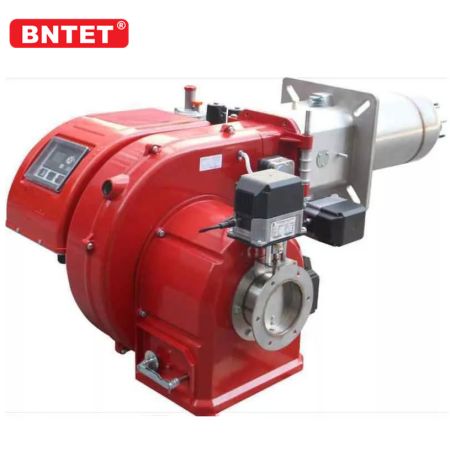
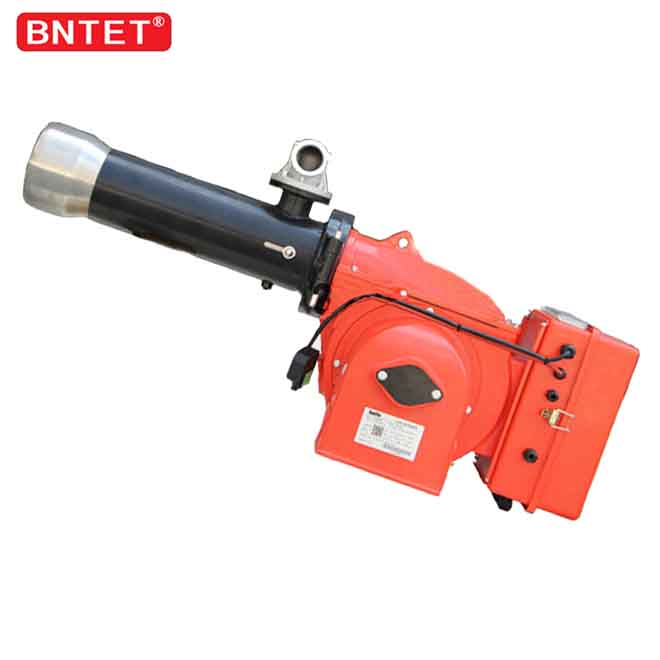
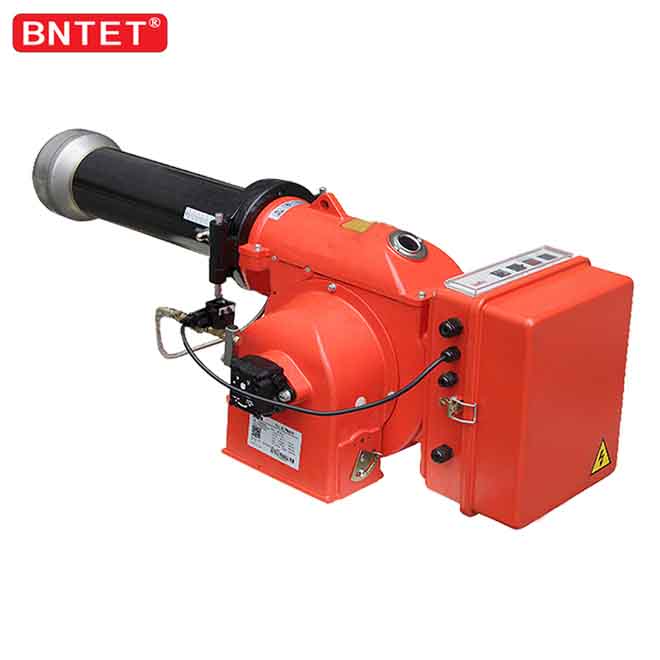
For heavy oil, either family can be correct. The choice depends on the viscosity of the fuel you will actually receive, the load range you need, and whether compressed air or steam is reliably available on site. BNTET's split-type heavy oil burner range (BNFT series) is offered with either high-pressure mechanical atomization or low-pressure medium atomization, and with a separate pump unit that includes the oil pump and filter [4]. Both options should be confirmed against a real fuel analysis rather than a grade name.
The system around the burner is the real difference
The burner itself is only part of the change. Most of the cost and most of the operating problems sit in the fuel system behind it.
| Subsystem | Light oil | Heavy oil |
|---|---|---|
| Storage tank | Standard tank sized for delivery intervals | Heated, insulated tank with water draw-off and sludge removal provisions |
| Fuel lines | Unheated; tracing only in cold climates | Insulated and traced, often with a circulation or return loop |
| Filtration | One fine filter is usually sufficient | Staged or duplex filters, cleaned far more often |
| Pumping | Small pump set at the burner | Separate pump unit, sized for higher viscosity, sometimes with a low-pressure circulation loop |
| Atomization | Pressure-jet | Preheating plus pressure-jet, or twin-fluid |
| Start-up | Quick cold start | Warm-up sequence before firing; some designs purge with light oil |
| Maintenance | Nozzle and filter service | Nozzle, filter, preheater, heater controls and tank cleaning, plus more spares |
| Operator skill | Moderate | Higher; temperature and pressure discipline matter daily |
Safety and installation requirements also change with the fuel. NFPA 31 addresses oil-burning equipment installed in residential, commercial and industrial occupancies, typically for No. 2 heating oil but also for lighter fuels such as kerosene and diesel, and heavier fuels such as No. 4 fuel oil [5]. In Europe, forced draught liquid fuel burners are normally assessed against EN 267 [8]. A burner approved for distillate fuel is not automatically acceptable for residual fuel: confirm the approved fuel range in the documentation, not only in the sales conversation.
Emissions, corrosion and permits
Sulfur in the fuel leaves the burner as SO₂, and a fraction of it oxidises further to SO₃, which combines with water vapour to form sulfuric acid. That raises the acid dew point of the flue gas, so any surface running below it — economiser, air heater, stack — becomes a corrosion site. Residual fuels also carry ash and metals that contribute to particulate emissions and to deposits, while fuel-bound nitrogen and flame temperature affect NOx.
Which limits apply depends on plant size, fuel and jurisdiction. Inside the EU, Directive (EU) 2015/2193 applies to combustion plants of at least 1 MW and less than 50 MW rated thermal input and sets emission limit values in Annex II for SO₂, NOx and dust; existing plants above 5 MW have had to comply since 1 January 2025, and existing plants of 5 MW or below from 1 January 2030, with a limited-hours exemption for plants running no more than 500 hours per year [6]. A local permit can be stricter than any of this, and other markets set their own limits.
Fuel supply has also moved. The IMO limit of 0.50% m/m sulfur in fuel oil used on board ships, in force since 1 January 2020, changed how refineries dispose of residual streams — heavy fuel oil being the distillation residue that previously carried much of that sulfur [7]. For land-based buyers the practical effect is that delivered residual fuel quality can vary more between suppliers and batches, which makes a written fuel specification per delivery and a retained certificate of analysis more valuable than the grade name on the contract.
Comparing cost honestly
Compare cost per unit of useful heat, not price per tonne:
Cost per useful MWh = fuel price per tonne ÷ (lower heating value × efficiency) × 3.6 + heating and pumping energy + maintenance and consumables
Use the lower heating value (LHV) consistently for both fuels. Mixing LHV for one fuel and higher heating value for the other flatters whichever number is larger.
An illustrative calculation, with assumed values only:
| Input | Light oil | Heavy oil |
|---|---|---|
| Delivered price (assumed) | 600 USD/t | 480 USD/t |
| Lower heating value (assumed) | 42.5 GJ/t | 40.5 GJ/t |
| Combustion efficiency (assumed) | 88% | 88% |
| Fuel cost per GJ of useful heat | 600 ÷ (42.5 × 0.88) = 16.04 USD/GJ | 480 ÷ (40.5 × 0.88) = 13.47 USD/GJ |
| Fuel cost per useful MWh | 57.8 USD | 48.5 USD |
The heavy oil case saves about 9 USD per useful MWh before tank heating, extra pump and heater electricity, filter cleaning labour and shorter nozzle life. That is the margin the system has to fit inside.
The same arithmetic gives the break-even: at an efficiency of 88% and a heavy oil LHV of 40.5 GJ/t, heavy oil must be delivered at roughly 572 USD/t to match light oil at 600 USD/t on energy alone — a discount of only about 5%. A discount smaller than that cannot pay for the extra equipment, however attractive the two headline prices look.
Two further cautions:
Heating is not free. Heat put into a storage tank and fuel line is heat the process does not receive, whether it comes from steam or from electricity.
Load profile matters as much as price. A plant that runs a few hours a week carries the full heating and maintenance burden with little fuel to spread it over.
Which option fits
| Situation | Light oil | Heavy oil | Dual fuel |
|---|---|---|---|
| Short, frequent runs; frequent cold starts | Strong fit | Poor fit; warm-up consumes much of the run | Adequate but adds cost |
| Long runs at steady high load | Works, higher fuel cost | Strong fit if fuel quality is consistent | Strong fit |
| Fuel supply interrupted seasonally | Depends on storage | Depends on storage and heating reliability | Best fit |
| Limited maintenance staff | Strong fit | Weak fit | Weak fit |
| Strict particulate or SO₂ limits | Usually easier | Requires flue gas treatment or cleaner fuel | Site-dependent |
| Fuel price volatility is the main risk | No hedge | No hedge | Allows switching between fuels |
If you are converting an existing installation
Work through the fuel system, not only the burner:
Confirm the burner's approved fuel range and the atomizer fitted.
Check preheater capacity and the temperature control point.
Verify pump and line sizing at the new viscosity, including suction conditions.
Review tank heating, insulation, water draw-off and sludge removal.
Confirm filter arrangement and cleaning access.
Review flue gas path materials against the acid dew point of the new fuel.
Check permit limits and any monitoring obligation before the first firing.
Plan spares and operator training for the new routine.
What to send for a burner quotation
| Information | Detail to include |
|---|---|
| Equipment | Boiler, thermal oil heater, dryer, kiln or furnace, with drawings or photographs |
| Heat demand | Maximum, normal and minimum load, and whether the figures are fuel input or useful output |
| Fuel | Grade plus a certificate of analysis; viscosity at two temperatures where available |
| Fuel supply | Pressure or pump arrangement, tank location, heating available on site |
| Combustion chamber | Dimensions, backpressure, mounting flange and available flame length |
| Control requirement | On-off, two-stage or modulating; signals available from the plant |
| Emissions | Applicable limits and any monitoring or reporting requirement |
| Site conditions | Ambient temperature range, altitude, power supply, utility air or steam availability |
FAQ
Can a light oil burner run on heavy oil?Normally no. The atomizer, preheater, filters and pump are sized for a much lower viscosity, and the safety documentation usually states the approved fuel range. Converting requires more than a nozzle change.
Can a heavy oil burner run on light oil?Often yes, with the correct nozzle, settings and control configuration, because the heavy oil design already includes preheating and a wider fuel system. Confirm this in writing for the specific model, and confirm the atomizing temperature is bypassed or reset for the lighter fuel.
Is heavy oil always cheaper?No. It has a lower heating value per tonne, it needs heating energy, and it usually needs more maintenance. It is cheaper only when the delivered price discount exceeds the efficiency and system penalties, and when emission limits allow it.
What viscosity do I need at the nozzle?The value your atomizer and pump are rated for — ask the burner manufacturer for that range, then read your own fuel's viscosity at the planned temperature from its viscosity-temperature curve.
Discuss your fuel and operating profile with BNTET
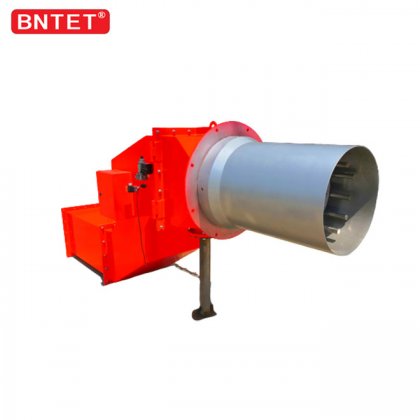
BNTET supplies diesel light oil burners with two-stage or modulating operation and mechanical atomization, and a heavy oil burner range that includes the split-type BNFT series with a separate pump unit and a choice of atomization methods. Where fuel availability or price is uncertain, dual fuel burners allow operation on gas and liquid fuel.
Send your fuel analysis, required heat load and operating hours through the contact page and the team can review which configuration fits your installation. If your load varies widely, it is worth reading how turndown ratio affects minimum firing rate before finalising the model.
Include viscosity at two temperatures, not just the grade name — that is the single number that decides whether the fuel system works.
References
ASTM International. ASTM D396-24: Standard Specification for Fuel Oils. https://www.astm.org/d0396-24.html
International Organization for Standardization. ISO 8217:2024: Products from petroleum, synthetic and renewable sources — Fuels (class F) — Specifications of marine fuels. https://www.iso.org/standard/80579.html
ASTM International. ASTM D341-20: Standard Practice for Viscosity-Temperature Equations and Charts for Liquid Petroleum or Hydrocarbon Products. https://www.astm.org/d0341-20.html
BNTET. Split Type Heavy Oil Burners BNFT Series. https://bntet-burner.com/product/Heavy-oil-burner/111.html
National Fire Protection Association. NFPA 31: Standard for the Installation of Oil-Burning Equipment, 2024 edition. https://www.nfpa.org/codes-and-standards/nfpa-31-standard-development/31
European Parliament and Council. Directive (EU) 2015/2193 on the limitation of emissions of certain pollutants into the air from medium combustion plants. https://eur-lex.europa.eu/legal-content/EN/TXT/?uri=CELEX%3A32015L2193
International Maritime Organization. Sulphur 2020 — cutting sulphur oxide emissions. https://www.imo.org/en/MediaCentre/HotTopics/Pages/Sulphur-2020.aspx
CEN. BS EN 267:2020, Forced draught burners for liquid fuels. (Standard designation; no public full-text link.)